Give every scientist a team ofexpert co-scientists
EMET gives you a coordinated team of specialized AI scientists — each built for a specific job in drug discovery, working in concert.
AI Agent
Most AI tools answer questions. EMET's agents conduct research.
Specialized domain agents
Target ID, Risk, Biomarker, and Competitive Analysis agents running in parallel across 16M closed-access papers and 858M curated biological nodes.
Compounding sequential handoffs
Agents don't work in isolation — each specialist hands off findings to the next, deepening the synthesis at every step to prevent missed safety signals.
200+ proprietary scientific skills
Each agent draws on encoded methodologies built by BenchSci's PhD scientists across target validation, translational biology, and experimental design.
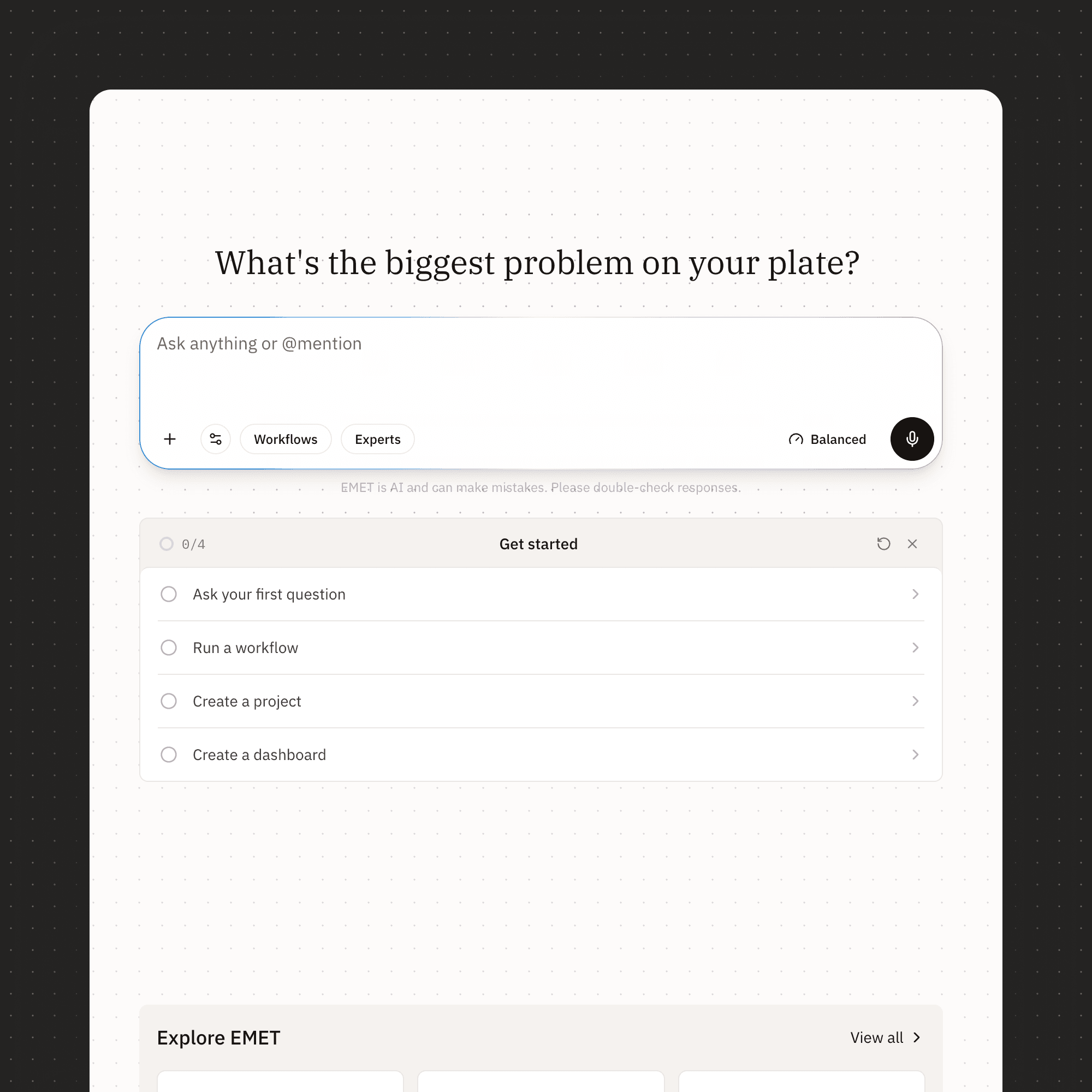
Specialized AI agents working in concert
Proprietary scientific skills built by PhDs
Of scientists report 25–60% efficiency gains
Data Analysis
From raw data to publication-quality insight in one conversation
AI-conducted analysis
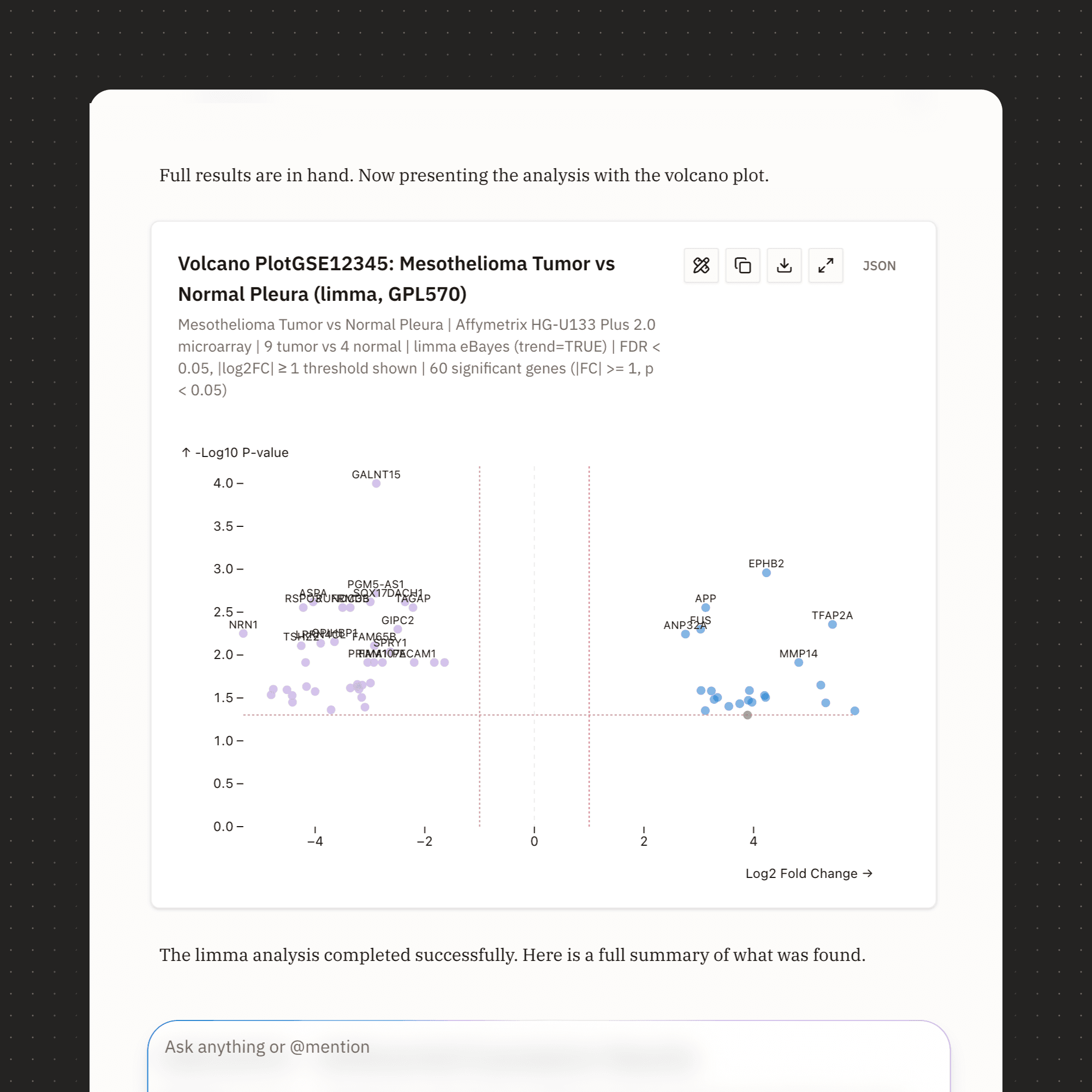
Execute R, Python, and thousands of scientific libraries directly inline — the scientist directs and validates while EMET performs the computation.
End-to-end multi-omics pipelines
Run differential expression on GEO cohorts, Galaxy-powered variant calling, pathway enrichment, and single-cell profiling without waiting in specialist queues.
Reusable organizational skills
Pipelines built by one researcher can be encoded as permanent organizational skills, making custom workflows immediately available across teams.
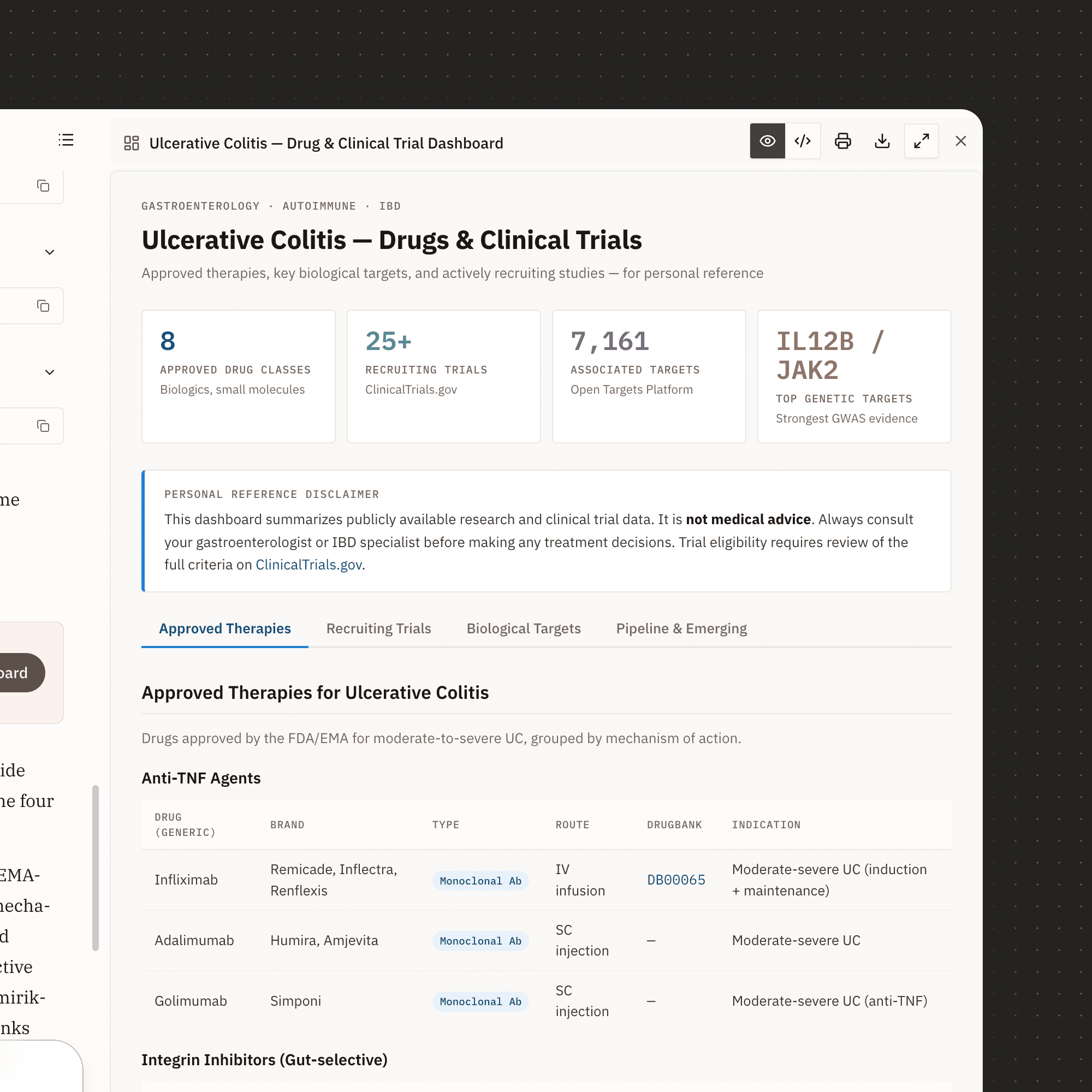
Visualizations
An analysis nobody can present doesn't change a program
45+ interactive data visualizations
Volcano, MA, and Manhattan plots, heatmaps, Kaplan-Meier curves, and 3D AlphaFold structures bound directly to your dataset and interactive in the chat.
Publication-quality figures
Generate pathway diagrams, mechanisms of action, and visual abstracts up to 4K adhering to strict journal styling (membrane-to-nucleus flow, proper notation).
Conversational and lossless editing
Refine figures conversationally ("make kinases coral") or edit layers losslessly; export presets for Nature, Science, and Cell at 600 DPI.
I asked it to hypothesize the structure. It said, 'I don't need to hypothesize.' Gave me the PDB entries, did its own coding, rendered an image. Really good.
Memory
Context you build once shouldn't have to be built again
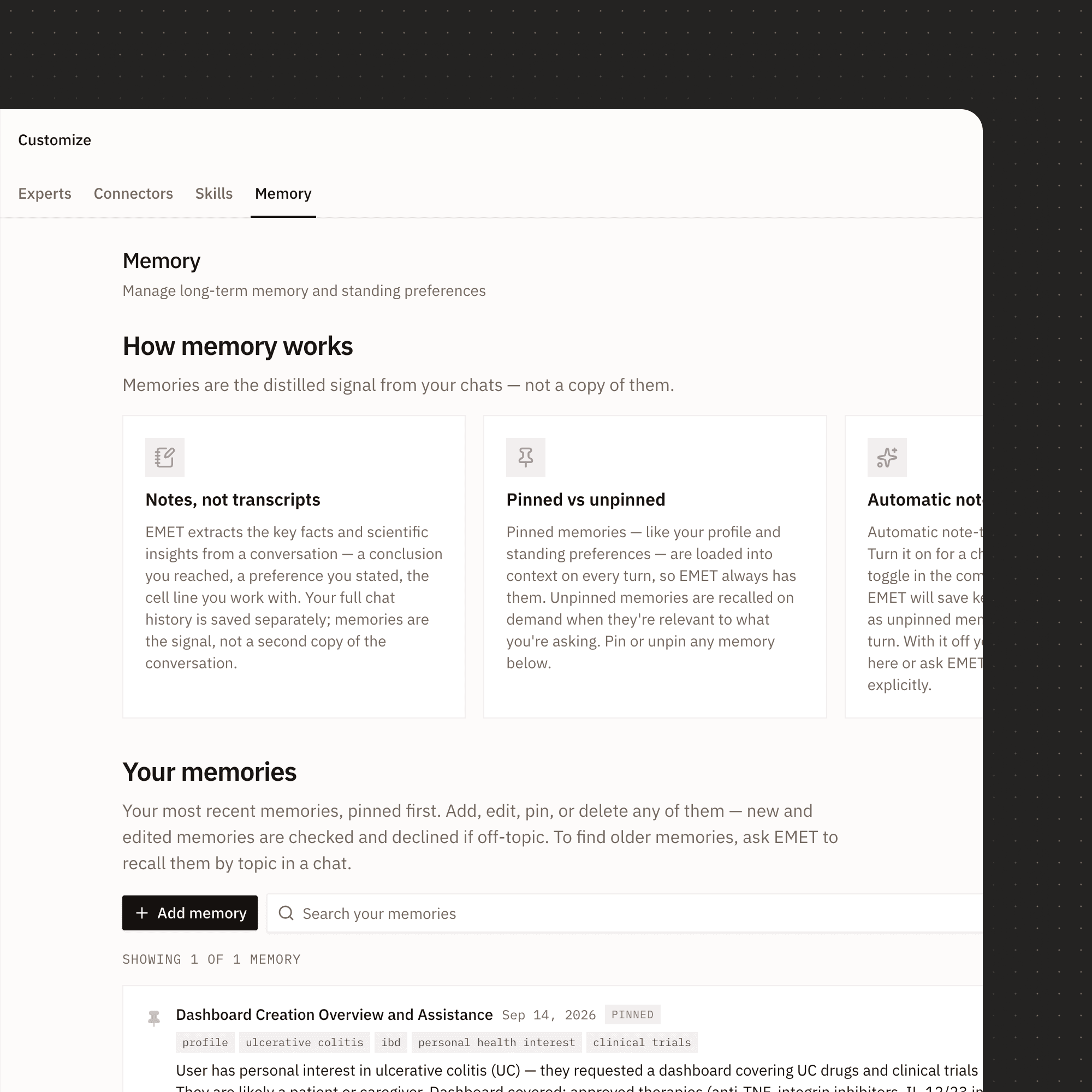
Three-part working context
Maintains your profile, standing directives (e.g. mouse-first, mechanism before clinical), and past conclusions with direct back-links to source conversations.
Entity-aware scientific recall
Recalls prior findings based on biological entities, publications, and experimental context rather than loose keyword matching.
Transparent control & privacy
Automatic capture is off by default. Review, pin, edit, or delete memories from a single page — and nothing you remember ever trains a model.
Drug programs fail when biology is misunderstood. EMET exists to close that gap — before it closes your pipeline.
Start free trial