EMET connects the closed-access science that general-purpose AI misses
Built over a decade, EMET links 2.2 billion evidence-backed relationships across 16M licensed full-text papers and figures, surfacing insights available nowhere else
Closed-access papers exclusive to EMET
Nodes across 30+ biological entity types
Evidence-backed relationship edges
The most complete evidence map of biology ever built.
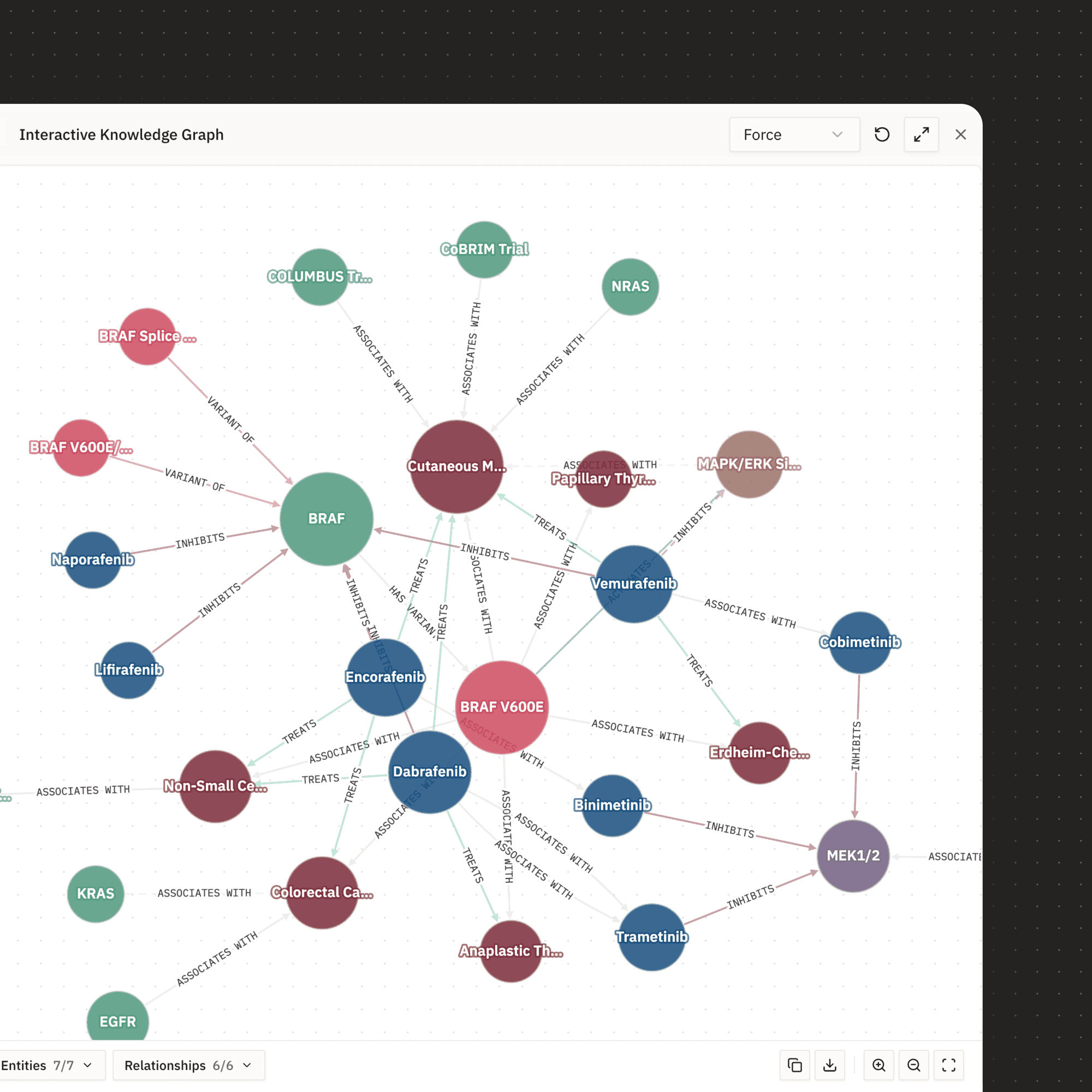
EMET is built on a biological evidence knowledge graph — a machine-readable map of how biological concepts relate to one another. Not a document index, but a structured record of what the literature has actually demonstrated.
Proprietary biological ontology
Underneath the graph sits our proprietary framework for how biological entities and relationships are defined, named, and connected. It reconciles the messy, inconsistent language of the literature — where one protein has five names and one term means three different things — into a single coherent structure.
Evidence-preserved traversal
Every node is a biological entity across 30+ entity types; every edge is a relationship drawn from a specific paper with the experimental evidence preserved alongside it. When EMET answers a question, it traverses that record to find the path from your question to the evidence that answers it.
PhD curation & dark data integration
Every data point is selected and curated by 60 PhD scientists before it enters the graph — delivering 95% completeness and fidelity for publication data across 100M unique biological concepts, 241 relationship types, and 80+ omics databases. At the highest integration tier, your internal dark data integrates directly into the graph.
I asked it to hypothesize the structure. It said, 'I don't need to hypothesize.' Gave me the PDB entries, did its own coding, rendered an image. Really good.
From your question to a cited, confidence-scored answer
When a researcher asks EMET to perform a task, a defined reasoning sequence runs underneath — not a single search, but a multi-step process that resolves entities, traverses relationships, retrieves evidence, and assesses confidence before returning an answer.
Entity resolution
EMET identifies biological entities in your question and resolves them to canonical identifiers ("breast cancer gene" becomes BRCA1, "Gleevec" becomes imatinib) — normalizing ambiguous names before reasoning begins.
Graph traversal
EMET navigates the 2.2 billion relationship network to find how your entities connect to other biological concepts: what a gene regulates, what proteins a drug targets, what diseases a pathway is implicated in. Multi-hop questions are handled natively.
Evidence retrieval
For each relationship surfaced, EMET retrieves the underlying evidence: the papers that established it, the experimental methods used, and specific findings reported — at the level of individual paragraphs and structured findings, not just abstracts.
Semantic search
Simultaneously, EMET searches across semantic embeddings to surface relevant evidence even when terminology differs (e.g., "cancer cell energy failure" retrieves studies on oxidative phosphorylation dysfunction and mitochondrial collapse).
Confidence assessment
EMET evaluates evidence strength: relationships supported by 10+ independent studies are classified as high-confidence; single-study findings are flagged as exploratory. Where studies contradict each other, EMET surfaces the conflict explicitly.
Cited answer
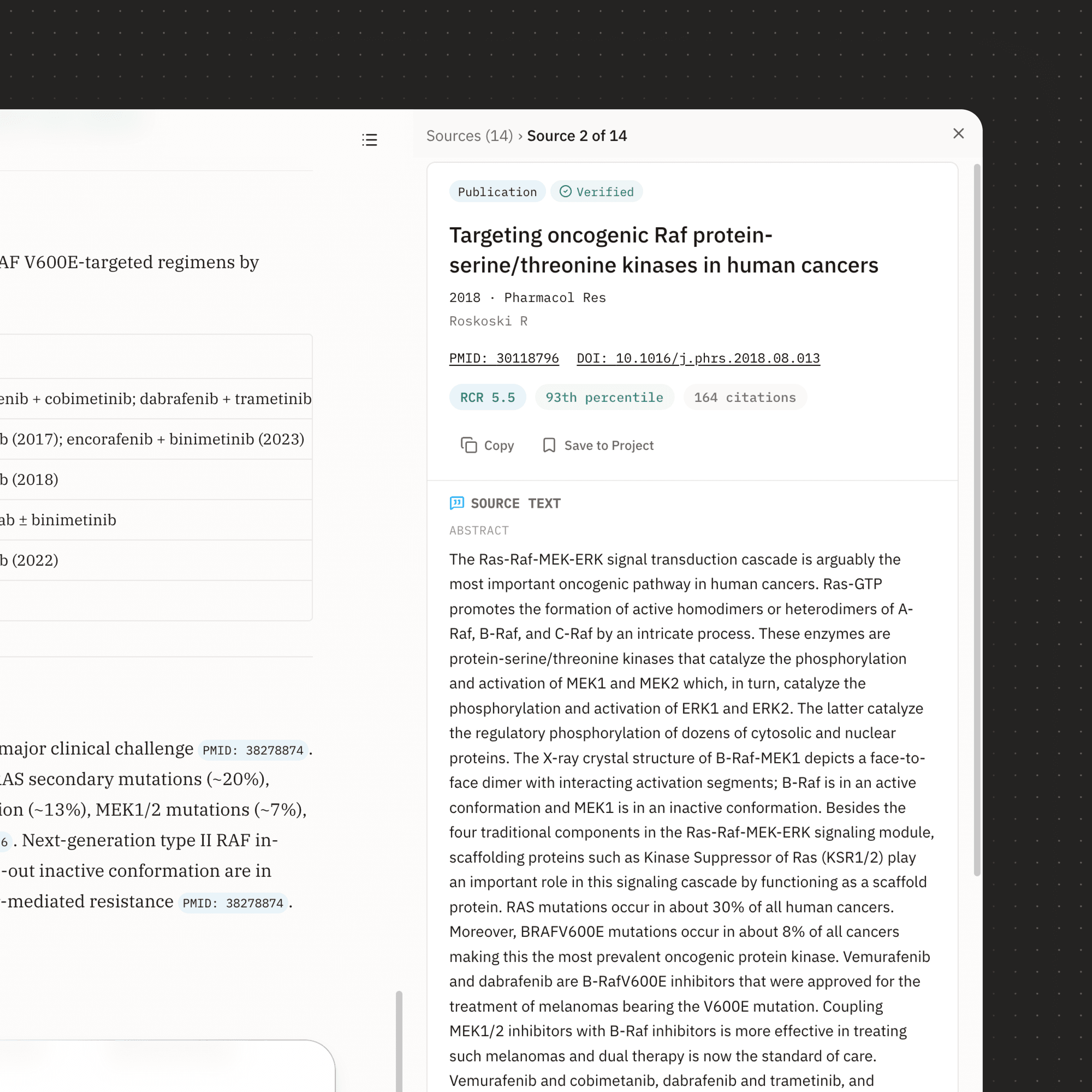
EMET returns a response in plain scientific language, with every specific claim linked to its source — a clickable DOI or PubMed ID, not a vague "studies suggest." If EMET can't cite it, it says so explicitly.
Not just papers. Structured scientific intelligence.
Beyond the knowledge graph, EMET searches a curated corpus of 16 million full-text closed-access papers, 780K patents, and 310K preprints through four specialized lenses built on eight years of legal publisher agreements. No general-purpose AI platform has it.
Papers — 16M indexed
Broad literature review and seminal work discovery. When a researcher needs to understand the state of a field, find founding studies, or identify which groups have published in a space, EMET searches at full-paper level with semantic understanding of the topic.
Passages — Paragraph-level precision
Protocols, methods, and contextual detail. When precision matters — finding the exact conditions under which an experiment was run, specific reagents used, or precise wording of a result — EMET retrieves the relevant passage from within the paper, not just the paper itself.
Findings — Distilled scientific discoveries
Structured insights classified by type: key discoveries, supporting evidence, mechanistic explanations, and negative results. Filter specifically for mechanistic findings when understanding a pathway, or surface negative results when the absence of an effect is scientifically critical.
Claims — Typed assertions with confidence ratings
Structured claims classified as therapeutic, mechanistic, causal, correlational, methodological, or diagnostic — and rated as high-confidence or tentative based on supporting evidence to show not just what was found, but how strongly it is supported.
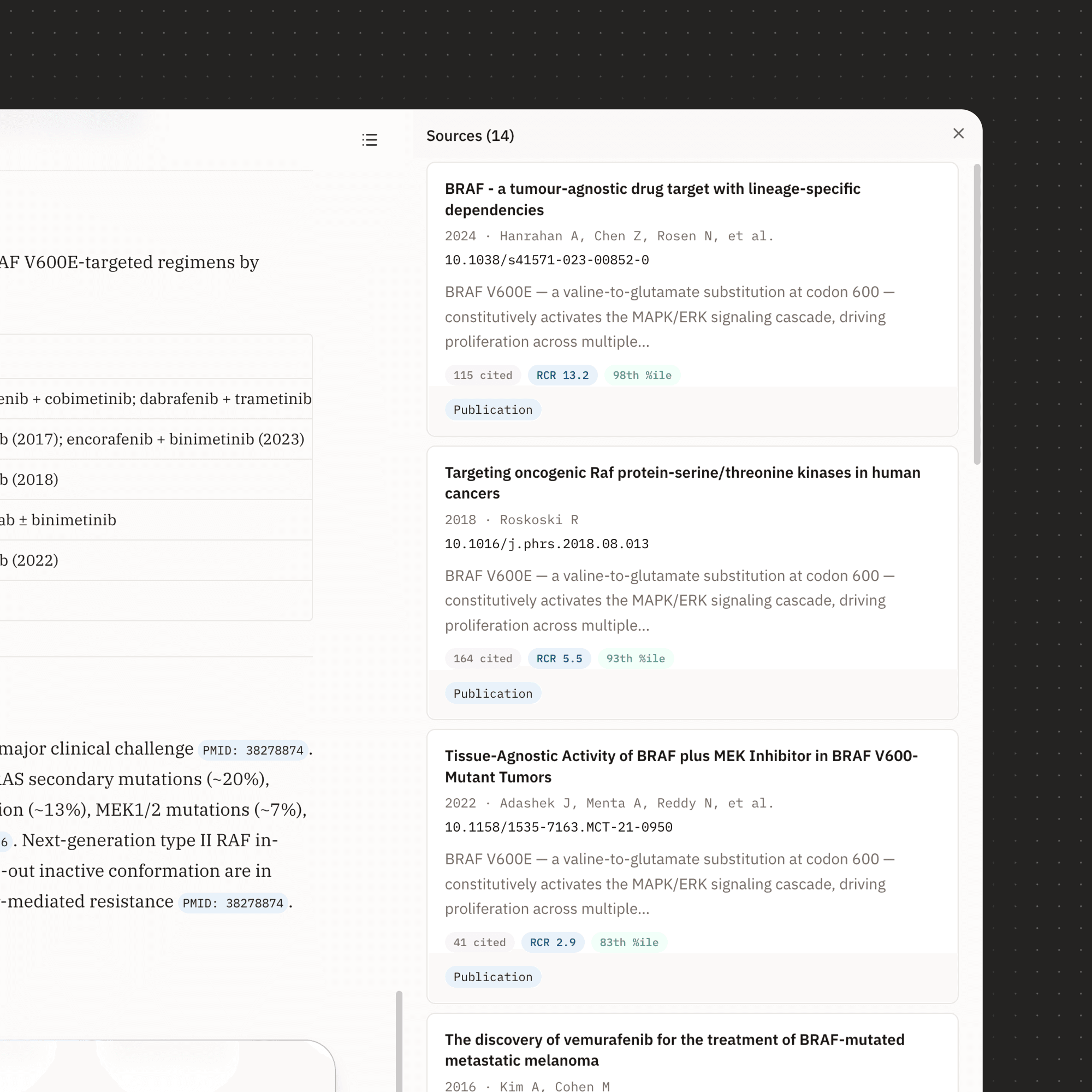
EMET tells you what it knows — and what it doesn't.
Most drug programs don't fail because of bad scientists. They fail because the biology was misread — a signal missed, a contradiction glossed over, a confidence that wasn't earned. The most dangerous thing an AI tool can do in drug discovery is project false certainty.
Citation-level provenance
Every factual claim EMET makes is linked to the source that established it — a specific DOI or PubMed identifier, not a database name or general reference. Researchers can click through to the originating paper at any point. If EMET can't cite it, it says so explicitly.
Calibrated confidence
EMET does not treat a single-study finding the same as a well-replicated result. Evidence strength is classified at three tiers — high confidence (10+ independent studies), moderate (3–9 studies), and exploratory (1–2 studies) — and communicated clearly in every response.
Explicit controversy & verified benchmark
The knowledge graph tracks both affirmed and negated relationships, surfacing genuine scientific conflict explicitly. On 20 critical drug discovery tasks, this architecture powers EMET's 93.0 score vs. ~75 for frontier models across 600+ tests and 8+ benchmarks.
Frequently asked questions
Drug programs fail when biology is misread. EMET is built to make sure yours isn't.
Request a demo